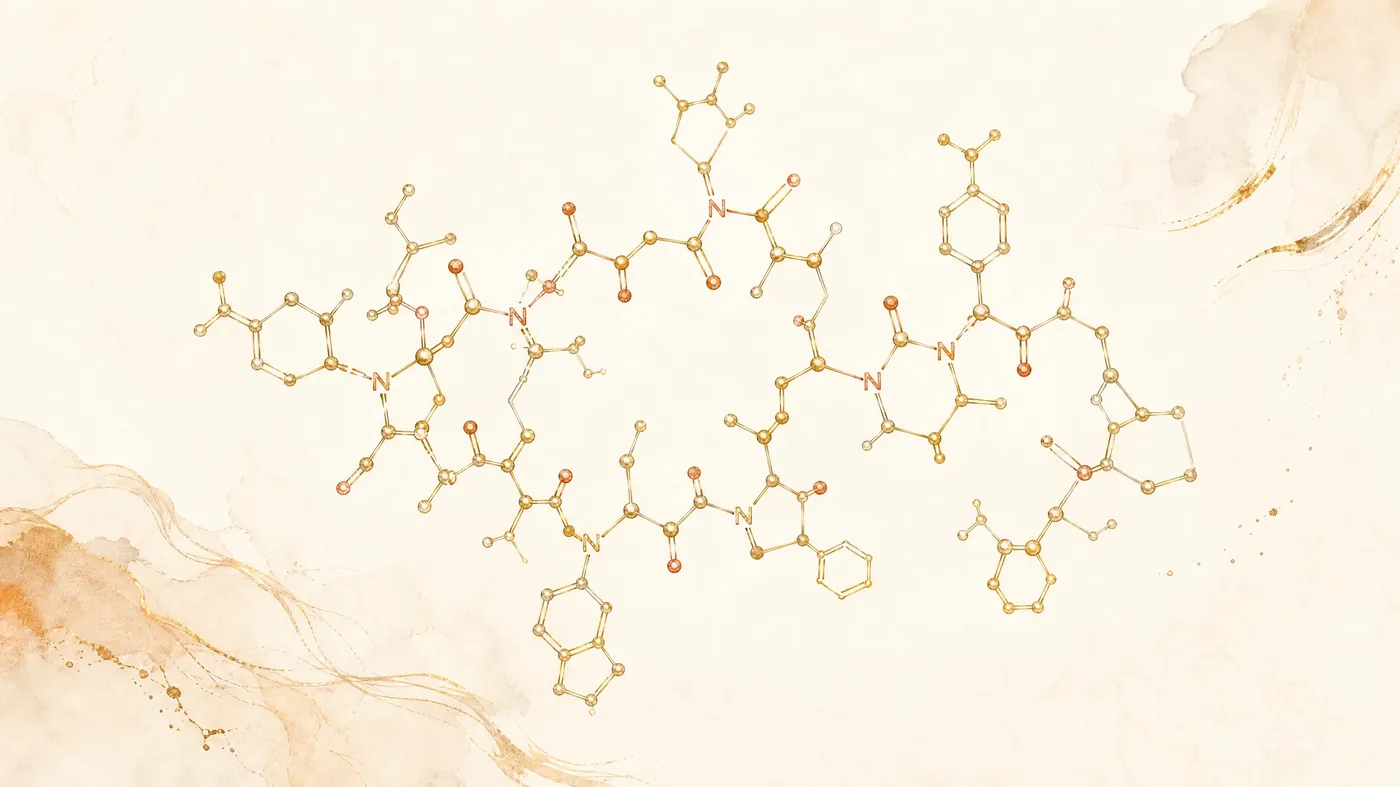

BPC-157 (Body Protection Compound-157) is a synthetic pentadecapeptide — a chain of 15 amino acids — derived from a protein found naturally in the gastric mucosa of mammals. Its full IUPAC name is L-Valyl-L-prolyl-L-prolyl-L-alanyl-L-alanyl-L-glycyl-L-glycyl-L-leucyl-L-glycyl-L-seryl-L-seryl-L-phenylalanyl-L-phenylalanyl-L-prolyl-L-prolyl-L-leucine. It is registered under CAS number 137525-51-0 and has a molecular formula of C₆₂H₉₈N₁₆O₂₂ with a molecular weight of 1419.55 g/mol.
BPC-157 is one of the most extensively studied synthetic peptides in preclinical research. Its stability in aqueous environments — unusual for peptides of its length — has made it a tractable subject for in vivo and in vitro investigation. Unlike many peptides that degrade rapidly in gastric acid, BPC-157 retains activity when administered via multiple routes in animal models, a property that has driven significant research interest into its mechanism of action.
The molecular mechanism by which BPC-157 exerts its effects in preclinical models is not fully characterized, but several pathways have been identified in published research. Studies have demonstrated interaction with the nitric oxide (NO) system, with BPC-157 appearing to modulate NO synthase activity in a context-dependent manner. Research published in the Journal of Physiology and Pharmacology has documented effects on the expression of growth hormone receptors in tendon fibroblasts, suggesting a role in the GH/IGF-1 axis. Additional work has implicated FAK-paxillin pathway activation, which plays a role in cell migration and wound healing responses.
The most extensively documented area of BPC-157 preclinical research concerns gastrointestinal tissue. Multiple studies in rodent models have examined its effects on the gastric mucosa, intestinal epithelium, and colonic tissue. Research published in Inflammatory Bowel Diseases and related journals has documented effects on mucosal healing in models of colitis, fistula formation, and anastomotic healing. The peptide's nomination to the FDA's 503A Bulks List in 2026 was specifically for the indication of ulcerative colitis, reflecting the concentration of human-relevant research in this area.
Musculoskeletal research represents the second major area of BPC-157 preclinical investigation. Studies published in the Journal of Orthopaedic Research and Muscle and Nerve have examined effects on tendon-to-bone healing, ligament repair, and muscle recovery in rodent injury models. Research groups have documented accelerated histological healing scores, improved biomechanical properties in repaired tendons, and reduced inflammatory infiltrate in treated tissue compared to controls. These findings have generated significant interest in the sports medicine and regenerative research communities.
Neurological research represents an emerging area of BPC-157 investigation. Preclinical studies have examined potential neuroprotective effects in models of traumatic brain injury, spinal cord injury, and dopaminergic system disruption. Research published in Brain Research has documented effects on dopamine system recovery in models of dopaminergic lesioning. Additional work has examined effects on serotonin and GABA systems. These findings are preliminary and require substantially more investigation before any conclusions about neurological mechanisms can be drawn.
For researchers designing in vitro studies with BPC-157, the peptide is typically supplied as a lyophilized (freeze-dried) powder. BPC-157 is generally considered stable at -20°C for up to 24 months when stored as lyophilized powder. Repeated freeze-thaw cycles should be avoided as they can degrade peptide integrity.
When sourcing BPC-157 for research purposes, the single most important quality indicator is the Certificate of Analysis (COA). A legitimate research-grade COA should include: (1) HPLC purity data showing the percentage of the target peptide relative to total UV-absorbing material, with research-grade compounds typically showing ≥98% purity; (2) Mass spectrometry (MS) confirmation of the correct molecular weight, confirming the peptide sequence is correct; (3) Endotoxin testing results, critical for any cell-based assays where endotoxin contamination would confound results; (4) The lot number, which should match the vial label; (5) The testing laboratory name and accreditation number.
Certificates for every lot we carry are published in the COA Library, and our guide on how to read a peptide COA explains each result.
The regulatory landscape for BPC-157 shifted significantly in 2026. On April 22, 2026, the FDA removed BPC-157 from the Category 2 list — the designation for substances flagged as posing significant safety risks for compounding — and on July 23, 2026, the FDA's Pharmacy Compounding Advisory Committee voted 8–6 to recommend adding BPC-157 to the 503A Bulks List. This recommendation, if adopted by the FDA, would allow licensed compounding pharmacies to produce BPC-157 for patients with a prescription. The vote is non-binding and the FDA has not yet issued a final ruling.
For researchers seeking to cite BPC-157 in academic work, the compound is referenced in the literature under several names including BPC 157, Body Protection Compound-157, PL 14736, and PL-10. The CAS registry number 137525-51-0 is the most reliable identifier for literature searches. PubMed searches for 'BPC-157' return over 150 published studies as of 2026, with the majority being rodent in vivo studies from research groups in Croatia, where much of the foundational BPC-157 research was conducted.