

Research Use Only · RUO
Size
Quantity
Bundle & Save
Ships in 2–5 business days · Free shipping on orders over $150
What is MOTS-c?
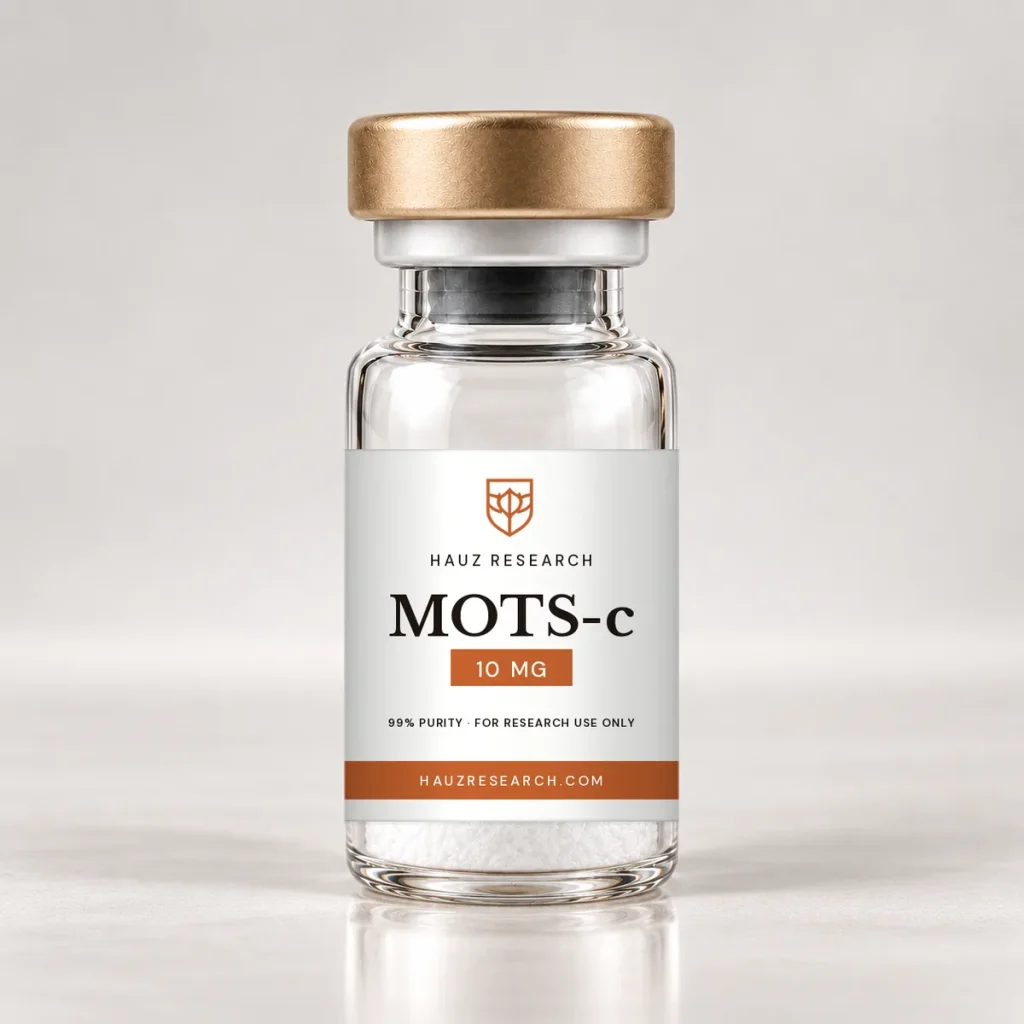
MOTS-c peptide is a 16-amino-acid mitochondrial-derived peptide, offered by HAUZ Research as a research compound in a 10 mg vial for laboratory use. Its name stands for “mitochondrial open reading frame of the 12S rRNA type-c,” which reflects where it is encoded: within the mitochondrial genome rather than the nuclear genome. Its amino acid sequence is Met-Arg-Trp-Gln-Glu-Met-Gly-Tyr-Ile-Phe-Tyr-Pro-Arg-Lys-Leu-Arg (MRWQEMGYIFYPRKLR).
MOTS-c has the CAS number 1627580-64-6, the molecular formula C101H152N28O22S2, and a molecular weight of 2174.6 g/mol. It belongs to a small group of mitochondrial-derived peptides that researchers study to understand how mitochondria communicate with the rest of the cell. More background is available in our MOTS-c research guide.
Origins and structure
MOTS-c was first described in 2015 by Changhan Lee and colleagues in the laboratory of Pinchas Cohen at the University of Southern California. The team identified a short open reading frame inside the mitochondrial 12S rRNA region and characterized the 16-residue peptide it encodes. Later work from the same research group examined how the peptide moves within cells and how its levels change in tissue samples.
Areas of laboratory research
- Discovery and pathway studies: Lee et al., 2015 described MOTS-c and studied it in cultured cells and in mice fed a high-fat diet, with analysis focused on skeletal muscle and the AMPK signaling pathway.
- Movement into the cell nucleus: Kim et al., 2018 examined, in cell-culture studies, how MOTS-c moves into the nucleus under metabolic stress and interacts with regulators of nuclear gene expression, including NRF2 and ATF1.
- Exercise and age-related models: Reynolds et al., 2021 studied MOTS-c in young, middle-aged, and older mice using treadmill and rotarod tests, in C2C12 mouse muscle cells, and measured naturally occurring MOTS-c levels in muscle and blood samples collected from volunteers before and after exercise.
Quality and verification
Every HAUZ Research lot of MOTS-c is independently tested for HPLC purity (99% or higher), identity by mass spectrometry, and endotoxin. The certificate of analysis for each lot is published in the COA Library, so researchers can match the lot number on their vial to its test results. MOTS-c is supplied as a lyophilized (freeze-dried) powder and is sold strictly for research use only.
Frequently asked questions
What is MOTS-c peptide studied for in research?
Published studies have examined MOTS-c in cell-culture and mouse models, looking at muscle cell signaling, the AMPK pathway, movement of the peptide into the nucleus under metabolic stress, and how its natural levels change with exercise and age.
What is the CAS number of MOTS-c?
The CAS number of MOTS-c is 1627580-64-6. Its molecular formula is C101H152N28O22S2 and its molecular weight is 2174.6 g/mol.
Is MOTS-c approved for human use?
No. HAUZ Research sells MOTS-c for laboratory research use only. It is not intended for human or veterinary use, is not a food or dietary supplement, and is not an FDA-approved drug in this form.
Published Research Summary
MOTS-c is a 16-amino-acid peptide encoded in the mitochondrial genome, first described by Lee et al. (2015), who studied it in cultured cells and in high-fat-diet mice with a focus on skeletal muscle and AMPK signaling (PMID 25738459). Kim et al. (2018) examined in cell culture how MOTS-c moves into the nucleus under metabolic stress and interacts with NRF2 and ATF1 (PMID 29983246). Reynolds et al. (2021) studied MOTS-c in mice of different ages and in muscle cells, and measured endogenous levels in human exercise samples (PMID 33473109).
All citations reference published literature. Not a claim of efficacy.
Store lyophilized peptide at -20°C. Protect from light. Upon reconstitution, store at 4°C and use within 14 days.