
Research Use Only · RUO
Size
Quantity
Bundle & Save
Ships in 2–5 business days · Free shipping on orders over $150
What is BPC-157?
BPC-157 is a synthetic research peptide made up of 15 amino acids (a pentadecapeptide). Its sequence is derived from a protein fragment first described in gastric juice, which is where the name “Body Protection Compound” comes from. It is one of the most frequently studied peptides in preclinical laboratory research, with a published literature that spans more than three decades.
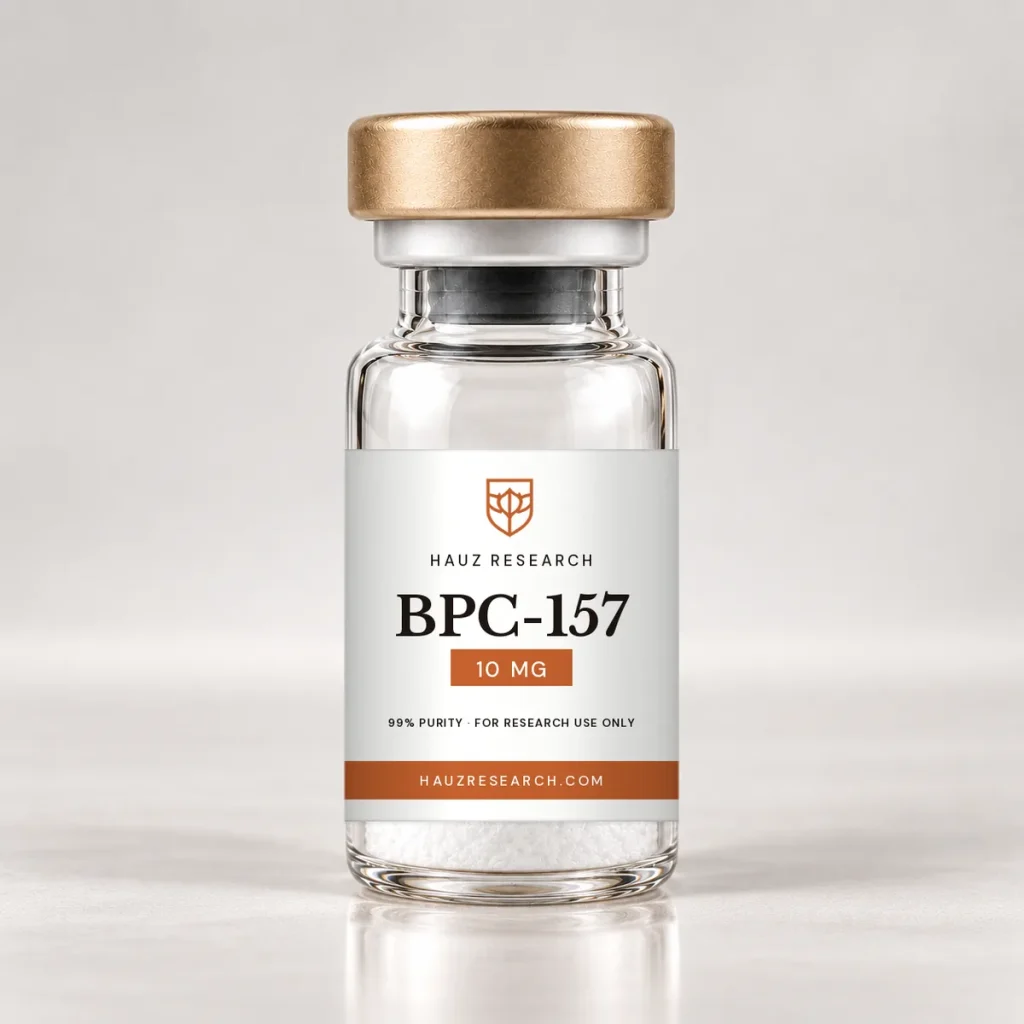
HAUZ Research supplies BPC-157 as a 10 mg lyophilized peptide with CAS number 137525-51-0, molecular formula C62H98N16O22 and a molecular weight of 1419.55 g/mol.
Origins and structure
The peptide was introduced in the early 1990s by a research group at the University of Zagreb, who described a gastric-juice peptide they called BPC (Sikirić et al., 1993). The synthetic 15-amino-acid sequence studied today is a stable fragment of that larger protein, and most of the published work on it has come from laboratory and animal studies.
Areas of laboratory research
- Tendon models in rodents. BPC-157 has been examined in rat Achilles tendon transection models and in tendon-cell (tendocyte) cultures (Staresinic et al., 2003), and in rat models of tendon-to-bone detachment (Krivic et al., 2006).
- Cell migration and survival in vitro. Cell-culture studies of rat tendon fibroblasts have looked at outgrowth, survival and migration of cells exposed to BPC-157 (Chang et al., 2011).
- Receptor expression. Researchers have measured growth hormone receptor expression in tendon fibroblasts cultured with BPC-157 (Chang et al., 2014).
These are animal and cell-culture findings, reported by the study authors. For a longer overview of the published literature, see our BPC-157 research guide.
Quality and verification
Every HAUZ Research lot of BPC-157 is independently tested for HPLC purity (99%+), identity by mass spectrometry, and endotoxin, and its certificate of analysis is kept in the COA Library. It is supplied as a lyophilized (freeze-dried) powder in a sealed vial. For research use only — not for human or veterinary use.
Frequently asked questions
What is BPC-157 studied for in research?
Published studies have mostly examined BPC-157 in rodent models and cell cultures, particularly tendon tissue and tendon fibroblasts, as described above.
What is the CAS number of BPC-157?
The CAS number of BPC-157 is 137525-51-0. Its molecular formula is C62H98N16O22 and its molecular weight is 1419.55 g/mol.
Is BPC-157 approved for human use?
No. BPC-157 is not an FDA-approved drug. HAUZ Research sells it for laboratory research only; it is not for human or veterinary use.
Published Research Summary
BPC-157 is a 15-amino-acid peptide first described by Sikirić and colleagues as a gastric-juice peptide (PMID 8298609). Laboratory studies have examined it in rat Achilles tendon transection models and tendocyte cultures (PMID 14554208), rat tendon-to-bone detachment models (PMID 16583442), tendon fibroblast outgrowth, survival and migration in vitro (PMID 21030672), and growth hormone receptor expression in cultured tendon fibroblasts (PMID 25415472). These are preclinical animal and cell-culture findings.
All citations reference published literature. Not a claim of efficacy.
Store lyophilized peptide at -20°C. Upon reconstitution, store at 4°C and use within 30 days. Avoid repeated freeze-thaw cycles.